Hand-drawn
A day, drawn as a journey
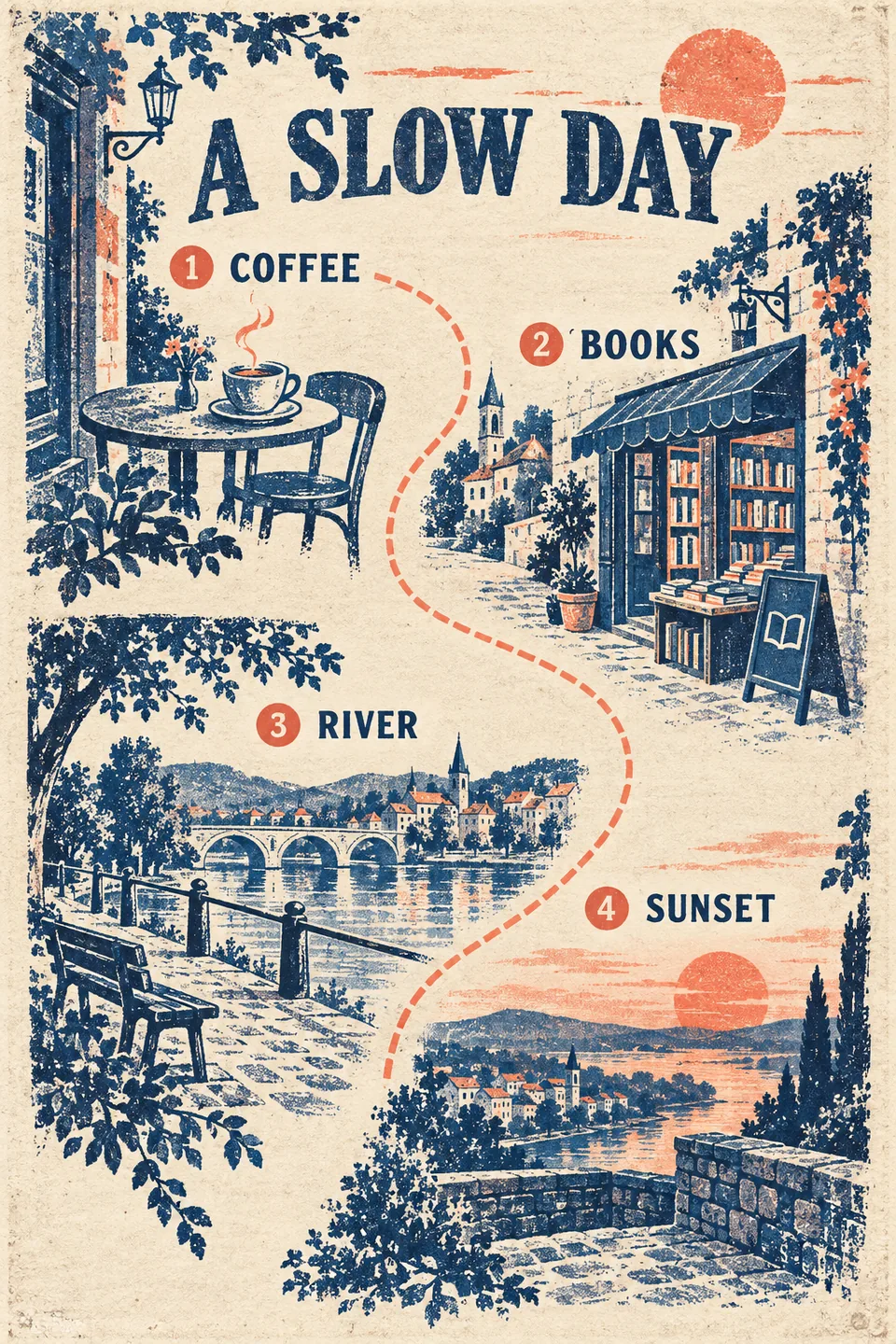
A risograph itinerary with a winding route and small illustrated stops.
Complete prompt
Subject: A leisurely day in a fictional riverside town: a morning coffee, a bookshop at noon, a riverside walk, then a sunset lookout. Title: “A SLOW DAY”. Four stops labeled “COFFEE”, “BOOKS”, “RIVER”, “SUNSET”. Portrait 2:3. Visual style: Warm ivory fibrous aged-paper ground. Limited two-ink printing in deep Prussian blue and muted coral red. Plenty of unprinted paper and large areas of negative space. Build forms with hand-drawn contours, etched hatching, intermittent dry strokes, coarse halftone grain, stippling and flat ink blocks. Uneven ink density, worn edges, paper texture showing through, slight two-color print misregistration and occasional ink dropouts. A simple spacious composition with a prominent subject and layered, distilled background. Evoke mid-twentieth-century vintage travel illustrations and the intimate literary nostalgia of a private sketchbook. Layout: Xiaohongshu infographic. Layout: path-map type, with one winding or game-map-like route crossing the canvas and several numbered nodes, locations, or stages along it. Pair each node with a small visual and one short explanation, using arrows, dashed lines, or signposts to show direction. It does not need to be a real map; emphasize the route and node relationships while preserving generous negative space. Palette: Theme color: Prussian Blue. Prussian blue with a muted coral accent on ivory paper. The subject brief is the sole source of content; style changes rendering only. Do not add unrequested brands, characters or artist signatures. Retain every requested module, quantity, action, composition, detail and constraint; do not summarize them away. Explicit user content, exact copy, color and no-text requirements take priority. A selected palette overrides only the style’s default colors, preserving its other characteristics. This layout is a schematic itinerary, not a geographic or navigation map. If the subject requests no text, draw no lettering, even in a layout with text areas. Otherwise integrate typography into the composition. Preserve any exact copy in the brief; otherwise develop meaningful copy in the subject’s language instead of literally describing the picture. For conceptual subjects, design a human or nonhuman visual metaphor first, then integrate words and image into one composition. Never shorten supplied copy unless asked. Use only supplied places, data and facts; never invent opening hours, prices or distances.