Spaces & scenes
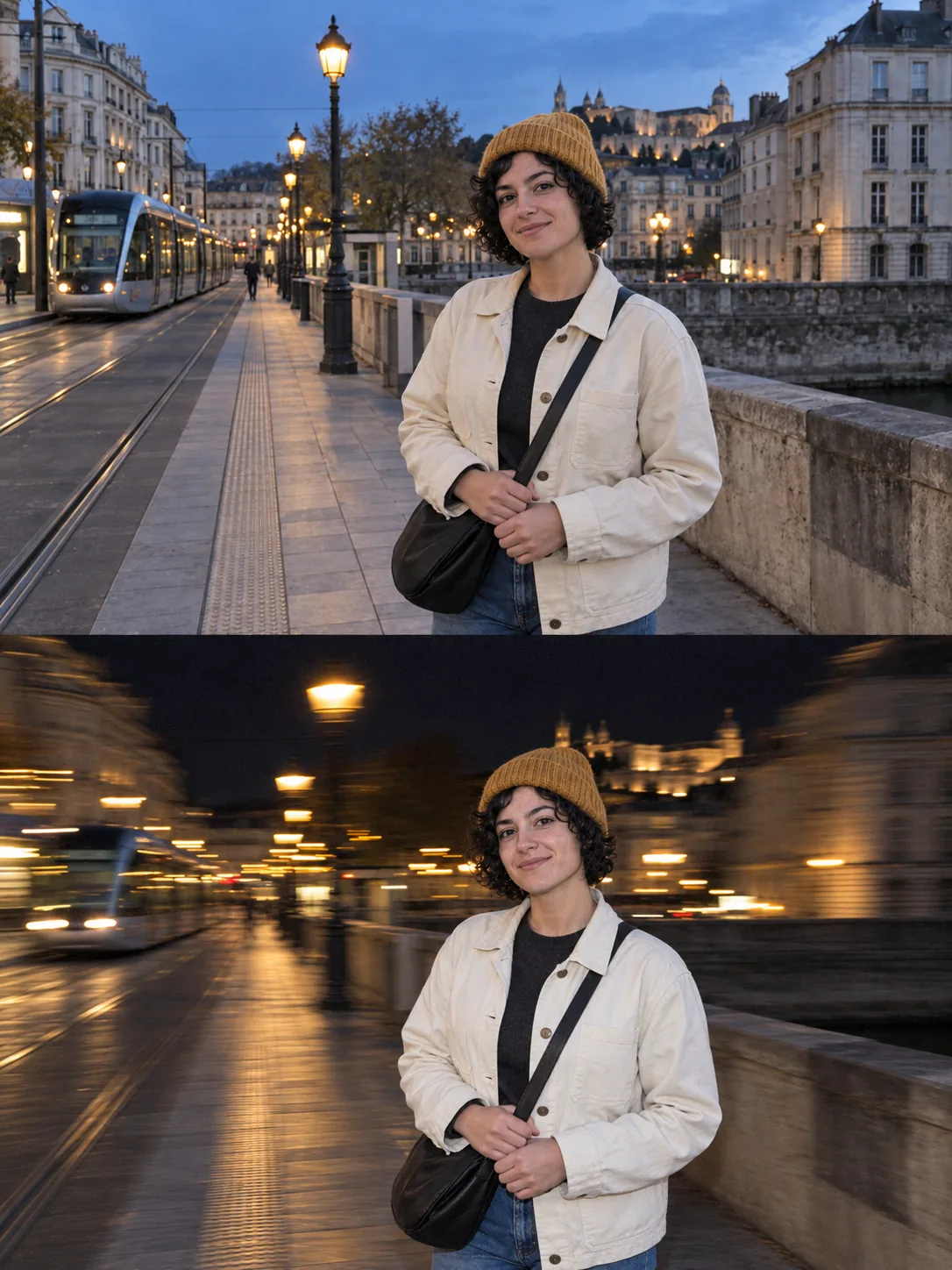
Night flash diptych
Keep the moment, change the exposure. A crisp portrait against a city in motion, paired with your original photo.
Complete prompt
Use my uploaded photo to make ONE portrait photographic diptych, overall 3:4. Divide the canvas into two stacked panels of exactly equal height and width, each taking half of the image. Keep the complete source framing in both halves; if needed, use minimal neutral padding rather than cropping or stretching. No extra panel, title band, captions, branding or watermark. UPPER HALF — ORIGINAL: retain the complete original photo, with at most a subtle color correction. Keep its original lighting, person, face, expression, clothes, pose, scene, camera viewpoint and composition. Do not blur or redesign this half. LOWER HALF — NIGHT FLASH: reconstruct exactly the same person, face, expression, clothes, pose, scene, viewpoint and composition as a believable candid nighttime photograph made with direct on-camera flash and a slow shutter. Freeze the face and central body sharply with a strong but realistic flash; preserve facial landmarks, eyes, hair, hands, anatomy, clothing texture and the subject's silhouette. ENVIRONMENTAL MOVEMENT: let the existing background, distant passersby, vehicles, streetlights and environmental highlights form natural motion streaks, light trails and faint edge afterimages in one coherent direction. Use right-to-left horizontal motion unless I specify another direction. Trail lengths may vary naturally with distance and movement. Do not invent people or vehicles absent from the source, and keep the original scene recognizable. PHOTOGRAPHIC FINISH: authentic low-light sensor noise, digital-camera grain, plausible flash falloff, a darker ambient exposure, slight exposure imperfections and the feeling of a spontaneous night snapshot. The subject is held still by the flash while the world appears to move around them. Keep natural skin and materials. CONSTRAINTS: no whole-photo blur, face replacement, changed expression or pose, redesigned wardrobe, different location or framing, conflicting blur directions, radial zoom, artificial neon overlays or conspicuously synthetic rendering. Exactly one complete main subject in each panel; it is repeated only for the before/after comparison. Afterimages belong only to moving edges and the surroundings, never a second complete main subject. Preserve every instruction and the equal split. Photographic cues: direct flash, slow shutter, motion blur, light trails, low-light grain, candid night photography.